

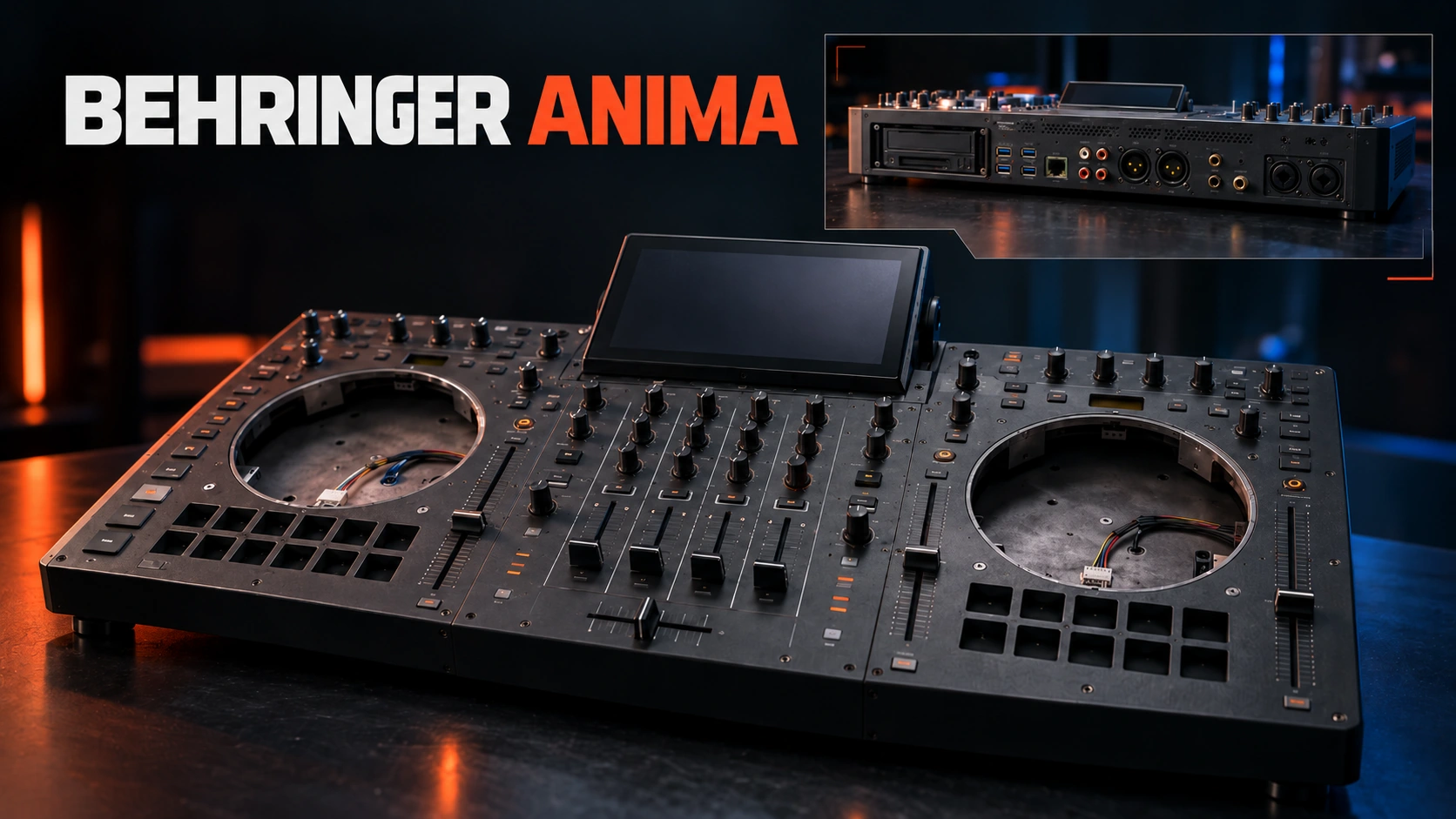
Behringer has shown a four-channel DJ system prototype with a proposed price of $300–$400. Its pitch combines open hardware, freedom from mandatory proprietary software lock-in and a format usually associated with far more expensive equipment. But a factory prototype is not the same thing as a club-ready product.
What has Behringer actually shown?
Photos shared in October 2026 show a unit marked ANIMA, with a Klark Teknik logo on its rear panel. The layout includes a four-channel mixer, two deck sections, eight vacant performance-pad positions per side, long pitch faders and a centrally positioned folding screen. The rear shows XLR outputs, microphone inputs, USB, Ethernet and a bay labelled HARD DISK.
This is an unfinished prototype: the jog wheels and physical pads are missing. No final specification sheet, working demonstration, processor details or retail date has been published. True standalone operation, without a laptop, remains to be publicly demonstrated.
The price challenges the industry's assumptions
The announced target sits far below established professional systems. DJ TechTools referenced the Denon DJ Prime 4 G2 at $2,599 and the AlphaTheta XDJ-AZ at $3,449. The gap is striking, but it says nothing about equivalent features, build quality, processing or reliability.
International reference prices reported by DJ TechTools on 27 October 2026; they may change and exclude local taxes.
Open hardware is the bigger story
Beyond the price tag, open hardware could give developers more control over what a DJ system can do. Behringer's parent Music Tribe has already put code for its KICK project on GitHub, illustrating an interest in community development.
That does not mean ANIMA currently runs Rekordbox, Serato, Traktor or Engine DJ. Potential interoperability is not verified native support, and no working operating system for the new device has been demonstrated. Experts have mentioned Mixxx as a possibility, not an announced software partner.
Potential advantages
A reliable four-channel unit with professional connections at this price could lower entry costs for independent DJs and small venues. An open ecosystem might also support customization, updates and longer equipment lifespans — provided proper documentation, spare parts and maintained software actually arrive.